-
Free Shipping
Orders $75 & Up
-
30-day Money Back
Guarantee*
-
100% Secure Online Shopping
SSL - Verified Merchant
CSB XTV1272F2-WT 12V AGM Wind Turbine Battery - Extreme Temperature VRLA
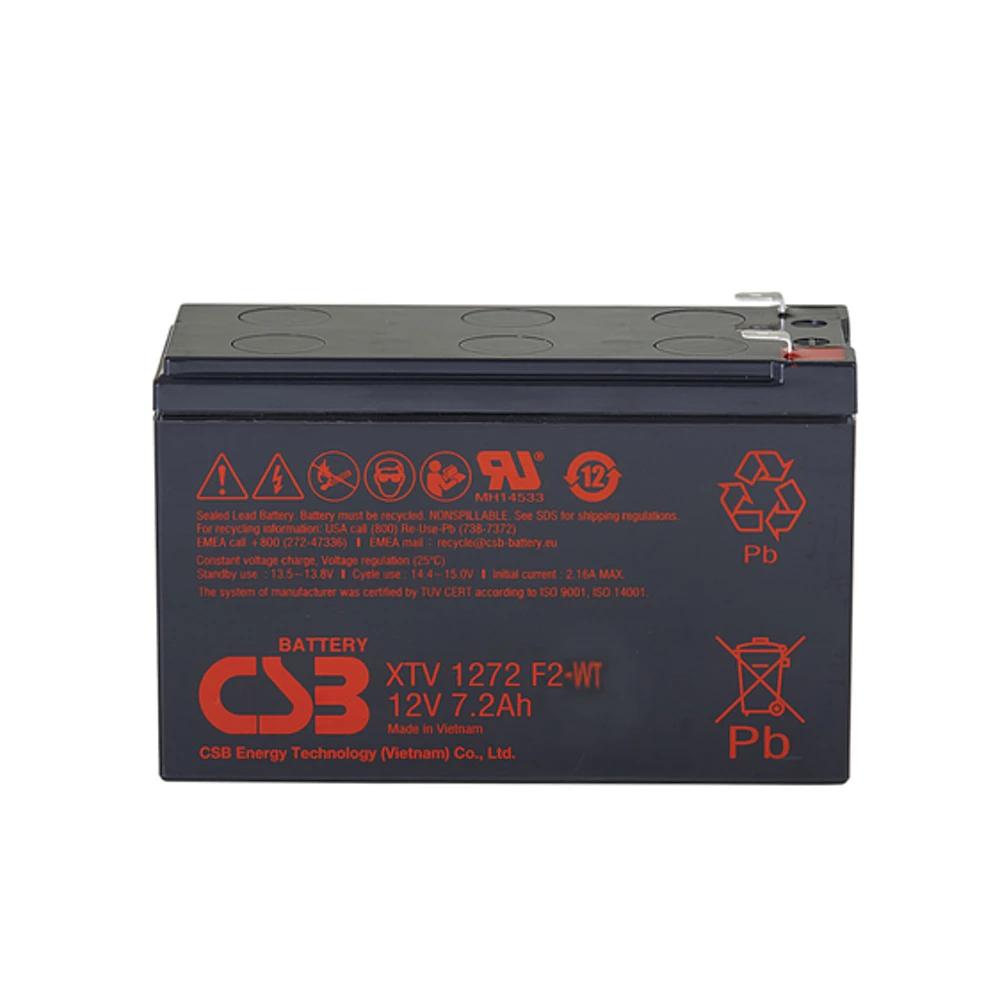
CSB XTV1272F2-WT 12V AGM Wind Turbine Battery - Extreme Temperature VRLA
CSB XTV1272F2FR-WT Battery - 12V 7.2Ah Wind Turbine AGM, F2
Warranty
Built for the Hub, Not the Cabinet
- 7.2 Ah nominal at the 20 hour rate - to 1.75 volts per cell at 25°C. The WT datasheet's own 20 hour table works out to 7.40 Ah, with 6.72 Ah at the 8 hour rate.
- 148 watts per battery at 15 minutes - to 1.67 volts per cell, and 145 watts to 1.75, from the WT series discharge tables.
- 130 amps maximum discharge - with 305 amps of short circuit current and an internal resistance of approximately 20.40 milliohms.
- 2.16 amps maximum charge current - the recharge ceiling a pitch system charger has to respect after a cycle.
- Less than 10 percent self-discharge over 90 days - storable for 6 months at 25°C before a full recharge is required, and sooner if stored warmer.
Technical Specifications
| CSB XTV1272F2FR-WT Specifications | |
|---|---|
| Part Number | XTV1272F2FR-WT (also written XTV1272F2-WT, XTV 1272F2-WT, XTV1272WTFR, XTV1272 WT and xtv1272f2-wt) |
| Series | XTV-WT, Extreme Temperature, wind turbine, 12 volt top terminal |
| Battery Type | AGM, valve regulated lead acid (VRLA), pure lead construction |
| Nominal Voltage | 12V |
| Nominal Capacity | 7.2 Ah at the 20 hour rate to 1.75 VPC at 25°C (CSB datasheet and price list) |
| Capacity, 20 Hour Rate | 7.40 Ah to 1.75 VPC at 25°C (datasheet capacity table) |
| Capacity, 8 Hour Rate | 6.72 Ah to 1.75 VPC; 6.56 Ah to 1.80 VPC |
| Watts Per Battery, 15 Minutes | 148 W to 1.67 VPC; 145 W to 1.75 VPC at 25°C (CSB XTV-WT tables, RA240531) |
| Discharge Current, 60 Minutes | 4.47 A to 1.67 VPC at 25°C |
| Discharge Current, 5 Hours | 1.24 A to 1.67 VPC at 25°C |
| Maximum Charge Current | 2.16 A |
| Maximum Discharge Current | 130 A |
| Short Circuit Current | 305 A |
| Internal Resistance | Approximately 20.40 milliohms |
| Terminal Type | F2 Faston tab, 0.250 inch |
| Length | 5.94 ± 0.08 inches (150.9 ± 2.0 mm) |
| Width | 2.55 ± 0.04 inches (64.8 ± 1.0 mm) |
| Height | 3.88 ± 0.04 inches (98.6 ± 1.0 mm) |
| Weight | 5.66 lbs (2.57 kg) |
| BCI Group Size | M7 (CSB price list) |
| Float Charging Voltage | 13.5 to 13.8 VDC per battery at 25°C (77°F) |
| Equalization Charging Voltage | 14.4 to 15.0 VDC per battery at 25°C (77°F) |
| Operating Temperature | Nominal 25°C (77°F); discharge and charge -20°C to 50°C (-4°F to 122°F); storage -15°C to 40°C (5°F to 104°F) |
| Self Discharge | Less than 10 percent after 90 days; store up to 6 months at 25°C, then recharge fully before use |
| Container Material | ABS, flame retardant to UL 94-V0, standard on the WT build |
| Standards | IEC 61056-1/2:2012; UL1989 Recognized (MH14533) |
| Design Life | Up to 12 years in standby service at 25°C; greater than 12 years on the Eurobat 20°C basis |
| Warranty | 3 years (CSB, XTV-WT) |
| Country of Origin | Vietnam |
| Stock Status at CSB | Stock item (CSB price list); the 12200-WT and 1250F2FR-WT are build-to-order |
Where This Battery Is Used
- Wind turbine pitch systems - the battery packs in the hub that drive the blades to feather if grid power or the converter drops out, cycling with every event and rotating with the rotor.
- Turbine controls and nacelle monitoring - condition monitoring and safety chain equipment mounted where vibration is constant and the temperature follows the season.
- Other high vibration renewable installations - equipment on a structure that moves, where a standard float block is being asked to survive a mechanical duty it was not built for.
Ordering and Freight
Frequently Asked Questions
What is different about the WT build if the discharge tables match the standard XTV1272F2?
The tables match because the plate set is the same 7.2 Ah design. CSB's published claim for the WT range is about what the battery survives rather than what it delivers: pure lead construction for charging efficiency, operation in a high vibration environment and better cycle performance, with the flame retardant case fitted as standard. A turbine hub cycles the battery every time the pitch system fires and shakes it the rest of the time, which is a different life from a cabinet on a pole. If the application is a stationary cabinet, the standard XTV1272F2 does the same electrical job on the same 3 year term.
Is this a gel battery?
No. The current CSB datasheet for this part describes it as an absorbent glass mat battery with pure lead construction, and it is charged on the AGM float window of 13.5 to 13.8 volts per battery. Older CSB literature for the XTV range used the phrase "hybrid gel"; the current sheet does not. Charge it as an AGM battery.
Can it be stored in the hub over winter?
Storage is the one place the WT sheet is tighter than the standard XTV sheet: -15°C to 40°C, against -20°C on the standard part, while discharge and charge are rated to -20°C on both. In practice a pitch battery is on charge whenever the turbine is energized, so the storage limit applies to spares on the shelf and to a turbine that has been de-energized for a season. Bring stored spares to a full charge before they go up the tower, and within 6 months of the last charge at room temperature.
Why does the datasheet show 7.40 Ah when the part is a 7.2?
CSB badges the XTV range by nominal 20 hour capacity, and the nominal figure on this sheet is 7.2 Ah. The capacity table on the same sheet, read at the 20 hour column to 1.75 volts per cell, gives 7.40 Ah. The difference is a measured figure against a rounded catalog number, and both are CSB's. Size a pitch pack on the nominal 7.2 and treat the extra as margin.
Tell a specialist the turbine model, how many batteries per hub and whether the original part was a 7.2 or a 12 amp hour block. The WT range and the standard XTV range share their electrical figures, so the decision is about the duty, and that is a two minute conversation.
Call 1-877-775-4381 · battery specialists, not a call centerWARNING: Cancer and Reproductive Harm - www.P65Warnings.ca.gov (State of California only).