


-
Free Shipping
Orders $75 & Up
-
30-day Money Back
Guarantee*
-
100% Secure Online Shopping
SSL - Verified Merchant
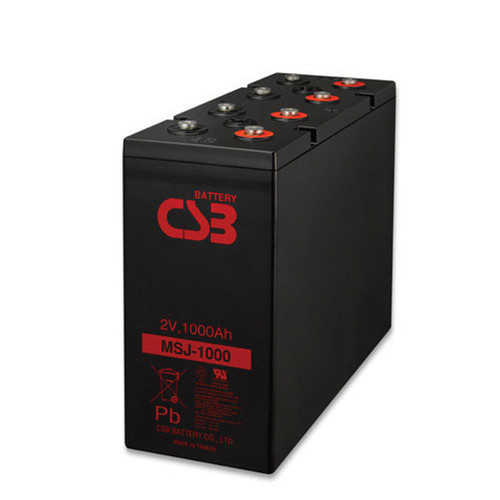
CSB MSJ-1000 2V 1000AH VRLA Battery - AGM Technology

CSB MSJ-1000 2V 1000AH VRLA Battery - AGM Technology
CSB MSJ-1000 Battery - 2V 1016 Ah Pure Lead AGM Cell for Large DC Plant
Warranty
Twice the Cell, the Same Cross Section and the Same Resistance
- 1,660 amps and 3,016 watts at 15 minutes - to 1.67 volts per cell at 25°C, which is the column a short transfer window is sized against.
- 300.00 amps maximum charge current - twice the MSJ-500 ceiling, so recharge time after a deep event holds even as the bank gets larger.
- 6,000 amps over 5 seconds - the published peak, which is inrush headroom rather than a sustained rating.
- Short circuit current is not published - CSB lists no figure for this cell where it gives one for every smaller MSJ. Request it from a specialist before finalizing protective device ratings.
- 2.21 to 2.25 VDC per cell on float - referenced to 25°C (77°F), with equalization at 2.35 VDC per cell; a 24 cell string and a 120 cell bank take the same per cell setting.
Technical Specifications
| CSB MSJ-1000 Specifications | |
|---|---|
| Part Number | MSJ-1000 (also searched as MSJ1000, MSJ 1000 and msj-1000) |
| Series | MSJ, 2 volt high capacity, top terminal |
| Battery Type | AGM, valve regulated lead acid (VRLA), pure lead construction |
| Nominal Voltage | 2V |
| Capacity, 8-Hour Rate | 1016.00 Ah to 1.75 VPC at 25°C (77°F) |
| Capacity, 20-Hour Rate | 1050.00 Ah to 1.75 VPC at 25°C |
| Capacity, 8-Hour Rate to 1.80 VPC | 984.00 Ah at 25°C |
| Discharge, 15 Minutes | 1,660 A and 3,016 W to 1.67 VPC at 25°C |
| Discharge, 1 Hour | 691 A to 1.75 VPC at 25°C |
| Discharge, 8 Hours | 127 A and 249 W to 1.75 VPC at 25°C |
| Maximum Charge Current | 300.00 A |
| Maximum Discharge Current | 6000 A (5 second rate) |
| Short Circuit Current | Not published by CSB for this cell |
| Internal Resistance | Approximately 0.28 milliohms |
| Terminal Type | I4 threaded copper alloy insert, accepts an M8 bolt |
| Terminal Torque | 109 ±22 lbf-in (126 ±25 kgf-cm, 12.3 ±2.5 N-m) |
| Depth | 18.54 inches (471.0 mm) |
| Width | 6.73 inches (171.0 mm) |
| Height | 13.15 inches (339.0 mm) |
| Weight | 160.45 lbs (72.80 kg) |
| Float Charging Voltage | 2.21 to 2.25 VDC per cell at 25°C (77°F) |
| Equalization Charging Voltage | 2.35 VDC per cell at 25°C (77°F) |
| Operating Temperature | Nominal 25°C (77°F); discharge -15°C to 50°C (5°F to 122°F); charge and storage -15°C to 40°C (5°F to 104°F) |
| Self Discharge | Less than 10 percent after 90 days at 25°C; storable to six months, and to ten months with an equalization charge |
| Container Material | Flame retardant ABS (UL 94-V0) |
| Standards | IEC 60896-21/22:2004; UL1973 Listed (MH66728); UL1989 Recognized (MH14533); TUV NORD to ISO 9001:2015 |
| Design Life | Up to 20 years in standby service at 25°C; greater than 12 years on the Eurobat 20°C basis |
| Warranty | 5 years (CSB, MSJ 2 volt range) |
| Country of Origin | Taiwan |
Where This Battery Is Used
- Building-scale DC power rooms - single strings carrying reserve that would otherwise need two banks in parallel and the monitoring that goes with them.
- Generating plant and transmission substations - long duty cycles under IEEE sizing, where the bank is expected to outlast the equipment it protects.
- Utility-scale float storage - installations judged on total connection count and maintenance hours as much as on amp hours.
Ordering and Freight
Frequently Asked Questions
Is the MSJ-1000 effectively two MSJ-500s in one jar?
On the published figures it behaves that way. Capacity is 2.01 times, weight 1.99 times, depth 1.95 times, and internal resistance is the same 0.28 milliohms. The difference that matters is structural: one jar means one set of terminals, one pair of intercell connections per position and one monitoring point, where two paralleled cells mean twice of each plus a current sharing imbalance that grows over the life of the bank.
Why is no short circuit current figure published?
CSB prints a dash in that row of the MSJ-1000 datasheet where it gives 5,075, 6,065 and 9,953 amps for the three smaller cells. We have not been given a reason and we will not estimate one by extrapolation, because a fault current figure used in a protective device calculation has to come from the manufacturer. If your design needs it, a specialist will request it from CSB in writing before the order is placed.
What does a full string weigh?
A 24 cell string for a -48 volt bus comes to roughly 3,851 lbs of cells before racking, hardware or cabling. A 60 cell substation bank is close to 9,627 lbs. Those numbers usually need a structural check on an upper floor or a mezzanine, and they decide whether the delivery needs a dock, a forklift or a liftgate.
How is a 160 lb cell installed into a rack?
With a lifting strap or a battery lifter rated for the load and two people, or a hoist where the tier is above waist height. The cell is 18.54 inches deep, so the load sits well forward of the handler and a two person carry by hand invites a dropped jar and a cracked case. Plan the access route and the lifting arrangement before the pallet arrives, not on the day.
Send the string count you run today, the reserve you have to hold and the floor you are installing on. A specialist works the cell count, the weight and the freight, and puts all three in writing.
Call 1-877-775-4381 · battery specialists, not a call centerWARNING: Cancer and Reproductive Harm - www.P65Warnings.ca.gov (State of California only).
Related Products




CSB HRL12330W AGM VRLA Battery for Douglas DSU12-350
