
UPS Battery Temperature
What a Warm Room Does to a UPS Battery String
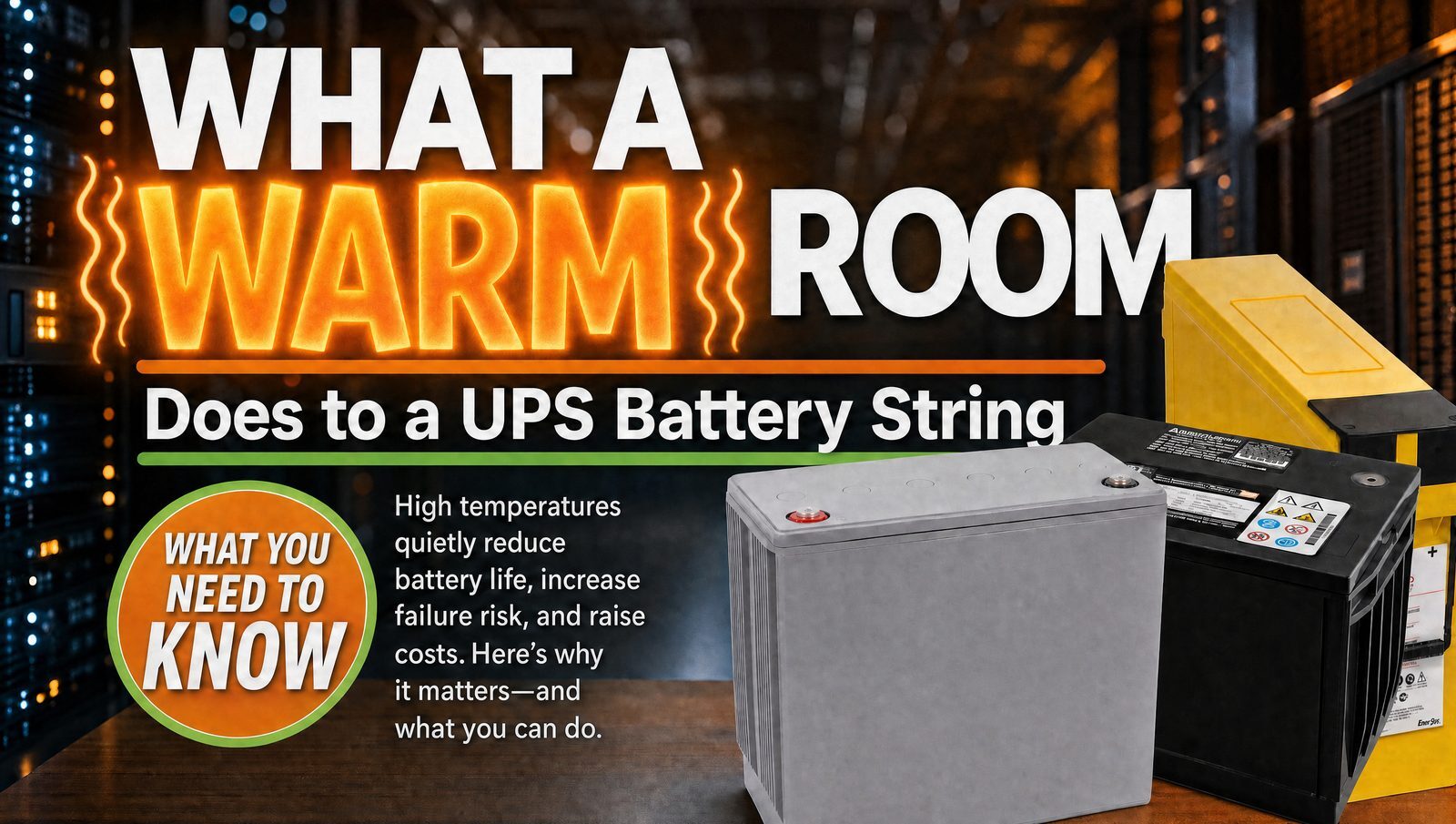
Cabinets sit next to rectifiers. Closets lose their cooling over a weekend. Outdoor enclosures bake all afternoon. The design life on a data sheet assumes a room that holds a controlled temperature, and a lot of battery rooms don't. A lead-acid string in a warm room ages faster than the same string in a cool one, and the room is rarely where anyone looks first.
Why heat shortens a string
A lead-acid battery ages through chemistry, and heat speeds that chemistry up. The positive grids corrode faster. A sealed VRLA jar loses water it cannot get back. The float current the charger pushes through the string rises with temperature, and that adds heat of its own. Heat doesn't break a battery. It runs the clock faster.
None of that shows on a self-test. It shows up years early, as a string that no longer carries its load.
How much heat takes off a string
You'll hear that lead-acid life roughly halves for every 15 to 18°F a battery runs above its rated temperature. That one holds up. It's what the manufacturers' own curves say, and it's what we see play out in the field. Treat it as a rule of thumb, not a spec. Manufacturers publish their own curves, and they don't agree on the starting point (some rate at 68°F, some at 77°F) or on how steep the drop is. The figure that applies to your string is the one on the data sheet for the jar in your rack. Send us the part number and we'll pull it.
The room thermostat is only half of it
A string can run hotter than the room it sits in. One end of a rack against a rectifier, a row of jars in the path of warm exhaust air, a cabinet door facing the sun: the thermostat on the wall reads fine while part of the string does not.
That's why we take a temperature at every negative post on a maintenance visit. One reading for the room would miss it. The pattern matters as much as the number. If one jar reads hot and the rest don't, that jar has a problem, or the spot it sits in does, and it gets a closer look. If every jar reads hot, the room is the last thing we blame. We check the age of the string first, then the charger, then the room.
What to do about a warm room
-
Measure it first. Log the room temperature every day for the whole season, at the same time each day, and take the temperature at every post on every visit. Keep it dated, in one place. Spring and summer are the seasons that cause the trouble, so those are the ones to log. Don't buy anything until you've seen the pattern. When a string fails early, that log is what shows whether the room did it.
-
Cool the room if you can. It protects every string in the room at once, and it's the fix we'd rather see.
-
Check the charger. Many UPS and rectifier chargers can adjust float voltage for temperature through a probe on the string. If yours can, make sure the probe is on the string and the feature is switched on. A float setting that's wrong for the temperature makes heat of its own. It's also the check most often skipped, which is why it's one of the eight on a PM visit.
-
If you can't cool it, change the build. A high-temperature build costs more, and in a room that holds its rated temperature it buys you nothing. If your readings come back near the data sheet's number, buy the standard line and put the difference toward cooling. The high-temperature build is the right spend when the string will sit in high heat for long stretches on a regular basis, call it 30 percent or more of its expected life, and the facility has no plan to fix the room. Then it's the one we'll quote.
Two numbers come with any high-temperature line, and they aren't the same thing. The warranty is what the manufacturer stands behind. Design life is what it expects from a controlled room, and it's the larger of the two.
C&D's high-temperature TEL series is rated to discharge from -40°F to 160°F. C&D warrants it for six years. Design life: 12 or more years, per the TEL-HT data sheet.
The other two lines we quote for heat are Deka's Fahrenheit series and the EnerSys PowerSafe SBS XL line. We'll confirm the warranty term for whichever fits your string in writing with your quote.
If your UPS is a rack-mount unit
A fully enclosed rack-mount UPS that takes battery cartridges has no high-temperature option. The batteries inside are small, and there's no heat-rated version we can swap in. That leaves two choices: build cooling into the closet, or budget for a shorter battery life. Those batteries run 3 to 5 years in a room that behaves. A hot closet takes it from there. Send us the model number and we'll tell you which of the two you're looking at.
Getting it quoted
Send the room's average temperature (the log, if you've kept one), the string size and the jar part number off the label. We'll tell you whether a standard build suits that room or whether the site needs a high-temperature build, and we'll confirm the warranty term for whichever you choose in writing with your quote.
The data sheet was written for a room your string may never see. Measure the one it lives in.
Written quote in 24 to 48 hours.