-
Free Shipping
Orders $75 & Up
-
30-day Money Back
Guarantee*
-
100% Secure Online Shopping
SSL - Verified Merchant
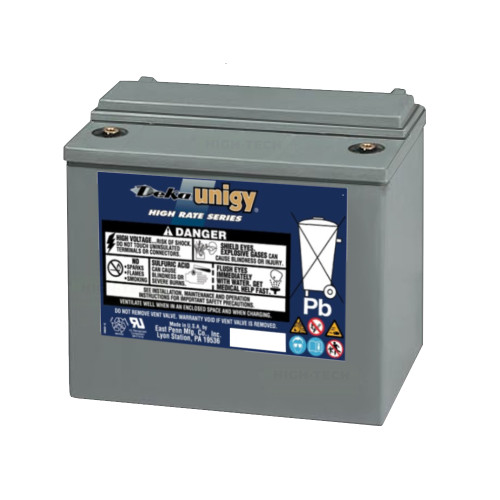
DEKA Unigy UPS HR3000 High Rate Series Battery
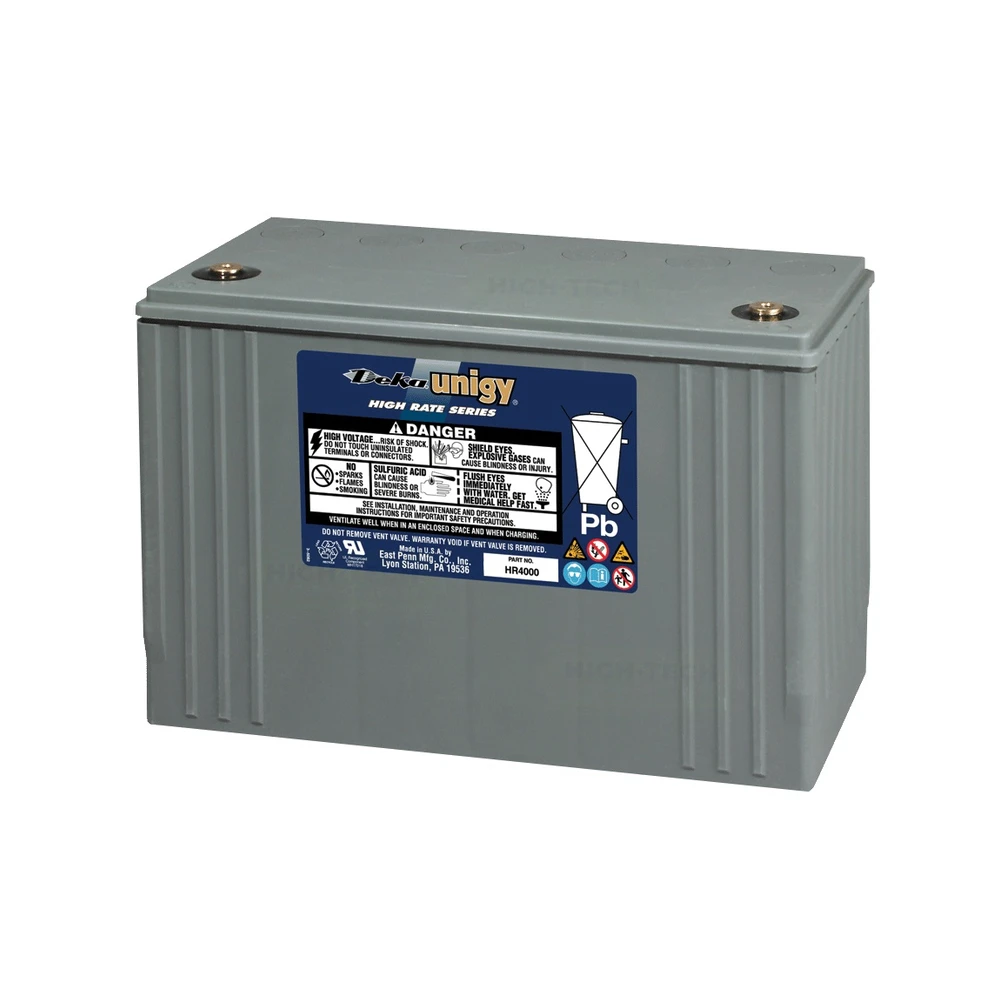
DEKA Unigy UPS HR3000 High Rate Series Battery
Deka Unigy HR3000 Battery - 12V 310W High Rate AGM
Warranty
What IPF Technology Buys You
- UL 1973 certified for energy storage applications, plus UL 94 V-0 flame-retardant case with better than 28% limiting oxygen index.
- Epoxy-sealed posts and heat-sealed case, 100% factory tested against leaks - electrolyte on a cabinet floor costs more to remediate than the battery costs to replace.
- Optional factory acceptance testing - East Penn will run a constant-power discharge at the 10-minute rate to 1.67 VPC, confirm the string at 100% and every jar at 95% or better, and give you a formal report with a factory baseline ohmic reading. It usually costs less than a site load test and it starts your IEEE 1188 trend on day one.
Technical Specifications
| Deka Unigy HR3000 Specifications | |
|---|---|
| Part Number | HR3000 (Deka Unigy High Rate series, East Penn Manufacturing; also searched as deka hr3000, east penn HR3000) |
| Battery Type | AGM, valve regulated lead acid (VRLA), IPF plate technology |
| Nominal Voltage | 12V |
| Rating | 310 watts per cell at the 15-minute rate to 1.67 VPC at 77°F - watt-rated, no amp-hour rating is published |
| Constant Power (1.67 VPC) | 972 W/cell at 1 min, 576 at 5 min, 400 at 10 min, 310 at 15 min, 188 at 30 min, 106 at 60 min |
| Positive Plate | Greater than 98% pure lead with tin-calcium alloy |
| Negative Plate | Pure lead, calcium alloy |
| Terminal Type | Top access, 1/4 inch - 20 threaded insert |
| Length | 10.20 inches (259.1 mm) |
| Width | 6.56 inches (166.7 mm) |
| Height | 8.24 inches (209.3 mm) |
| Weight | 61.5 lbs (28 kg) |
| Float Voltage | 13.50V per battery, plus or minus 0.5% at 77°F (range 13.42V to 13.57V) |
| Case | Flame-retardant polypropylene, UL 94 V-0, LOI greater than 28% |
| Safety Vent | Low positive pressure, self-sealing with flame arrestor |
| Certification | UL 1973 certified for energy storage; meets or exceeds IEEE recommended practices |
| Design Life | 10 years on float at 77°F (East Penn) |
| Warranty | 3 years top terminal (East Penn EPM 0986 Rev. 4/12) |
| Minimum Order | 4 units |
Where This Battery Is Used
- UPS strings in data centers and colocation - the high-rate ride-through to generator transfer.
- Network operations centers - where the string is the last thing between the rack and a hard drop.
- Switchgear and substation control power - tripping and closing current on a maintained float charge.
- Process control and manufacturing - orderly-shutdown power for lines that cost more to restart than to hold up.
- Healthcare and life-safety systems - backup that gets inspected and load-tested on a schedule.
Ordering and Freight
Frequently Asked Questions
What is the amp-hour rating of the HR3000?
East Penn does not publish one, and that is deliberate. High-rate UPS cells are rated in watts per cell at a specified discharge time and end voltage, because that is the number a UPS sizing table asks for. The HR3000 is 310 watts per cell at 15 minutes to 1.67 VPC. If someone hands you an amp-hour figure for this part, ask where it came from - it is almost certainly a conversion someone did themselves.
Is the HR3000 warranty 3 years or 4?
Three. East Penn's telecom high-rate warranty gives 4 years to front-access units and 3 years to top-terminal units, and the HR3000 is top access. Four-year claims on this part usually come from the 08/2022 consolidated form, which is UPS-scoped and does not govern reserve-power telecom applications. The governing document is East Penn form EPM 0986 Rev. 4/12, and we will send it with your quote.
How do the HR3000 and HR3500 differ?
Watts, mainly. Both sit in the same Unigy High Rate family and the HR3500 carries a higher constant-power rating. If your string is spec'd in watts per cell at a stated discharge time, match that number - do not substitute on physical size alone, because the cases are close and the ratings are not.
What is factory acceptance testing and is it worth it?
East Penn will discharge your batteries at the factory at the 10-minute rate to 1.67 VPC, confirm the string delivers 100% of rating with every individual jar at 95% or better, take conductance readings first, and send a formal report. For a site that will be commissioning-tested anyway it usually costs less than a site load test, and the baseline ohmic reading it establishes is the starting point of your IEEE 1188 trend. Ask for it with your quote.
What float voltage should I set?
13.50V per battery at 77°F, with an acceptable band of 13.42V to 13.57V. That is tight, and it matters: chronic overfloat is the most common installation error that turns a ten-year design life into a five-year one.
How do I confirm the HR3000 is the right battery before ordering?
Send a photo of the label on the unit you are replacing plus the tray dimensions. Watt rating, terminal type and footprint are the three that have to match. We would rather talk you out of the wrong battery than process the return.
Send the quantity, your delivery ZIP and your requested-by date. A specialist confirms availability, the warranty term, volume pricing and freight in writing, with no obligation to buy.
Call 1-877-775-4381 · battery specialists, not a call centerWARNING: Cancer and Reproductive Harm - www.P65Warnings.ca.gov (State of California only).